The pre-seed/seed stage founders' guide to SEO & AI search optimization

Thenuka Karunaratne
CEO & Co-Founder, sunbeam
5 min read
Much has been written about SEO & AI search optimization, but I’ve seen very little content focused on the specific challenges faced by very early stage teams—usually at the pre-seed, or seed stages, where they have little-to-no domain authority, a limited budget to invest in SEO, and a fraction of a person’s time to dedicate to the channel.
This essay focuses on the specific nuances that early-stage teams should consider as they begin their SEO and AI search journey.
1. SEO & AI search will rarely be your first acquisition channel
My first piece of advice to early-stage founders is that SEO & AI search is rarely* going to be your first customer acquisition channel. Building an organic search presence takes a lot of upfront time investment, and is doubly frustrating for founders because progress is slow at the beginning.
There’s a specific reason for this—as a new startup, your domain has few backlinks. Because the search indexes underlying Google’s AI overviews, ChatGPT, and Claude all use backlinks as a signal of authority, you’re typically at a structural disadvantage against older, more established competitors.
In practice, this means that it’s very unlikely you’ll be able to rank in top positions for keywords and prompts that are already contested by established competitors. The territory you can take immediately will usually be from uncompetitive keywords or prompts, with lower search volume (more on this in point #3).
If you’re a new startup trying to rapidly scale customer acquisition to raise another round in 6 to 12 months, don’t expect SEO and AI search to be what propels you there. Paid ads, LinkedIn organic social events, and other channels are often far faster to activate.
With that said, if you can stomach the initial slog, SEO, when done well, can compound exponentially, creating a low-cost, extremely scalable channel for user acquisition—this is why companies still choose to invest in it, despite the difficulty of getting started.
An underrated predictor of success is simply the persistence of the company over a long period of time. I’ve personally experienced many cases where customers are growing traffic 50% MoM, complain that it’s too slow, get frustrated that there isn’t some accelerant they can push overnight, and subsequently give up. The best teams I’ve personally worked with moderate their expectations and take a long view on success.
*I said rarely because there are certain businesses, for which SEO & AI search is so fundamental to the way their customers are reached, that it becomes a P0 priority from day one. Zillow or NerdWalletare good examples of this—they don’t have a business without organic search, so they have to commit to winning it from day one.
2. “We want to do AEO/GEO, not SEO!”
There’s a common, but completely misinformed, view that AI search has created a window for companies that were previously behind in SEO to “leapfrog” their competitors by beating them in AI search and circumventing SEO altogether. The flawed assumption at the basis of this view is that the fundamental drivers of performance for SEO & AI search lack a common basis, with AI search having a totally distinct and separate set of factors that you can optimize for, outside of SEO.
This is false. It’s true that there are differences between the way ChatGPT and Google crawl and index sources—for example, it’s well-documented that Google’s crawlers have little difficulty executing Javascript, while the crawlers of most major frontier labs have difficulty with it—but small differences apart, the core levers for improving visibility in SEO & AI search, which comprise technical SEO health, creating high quality content, and having strong domain authority, remain the same.
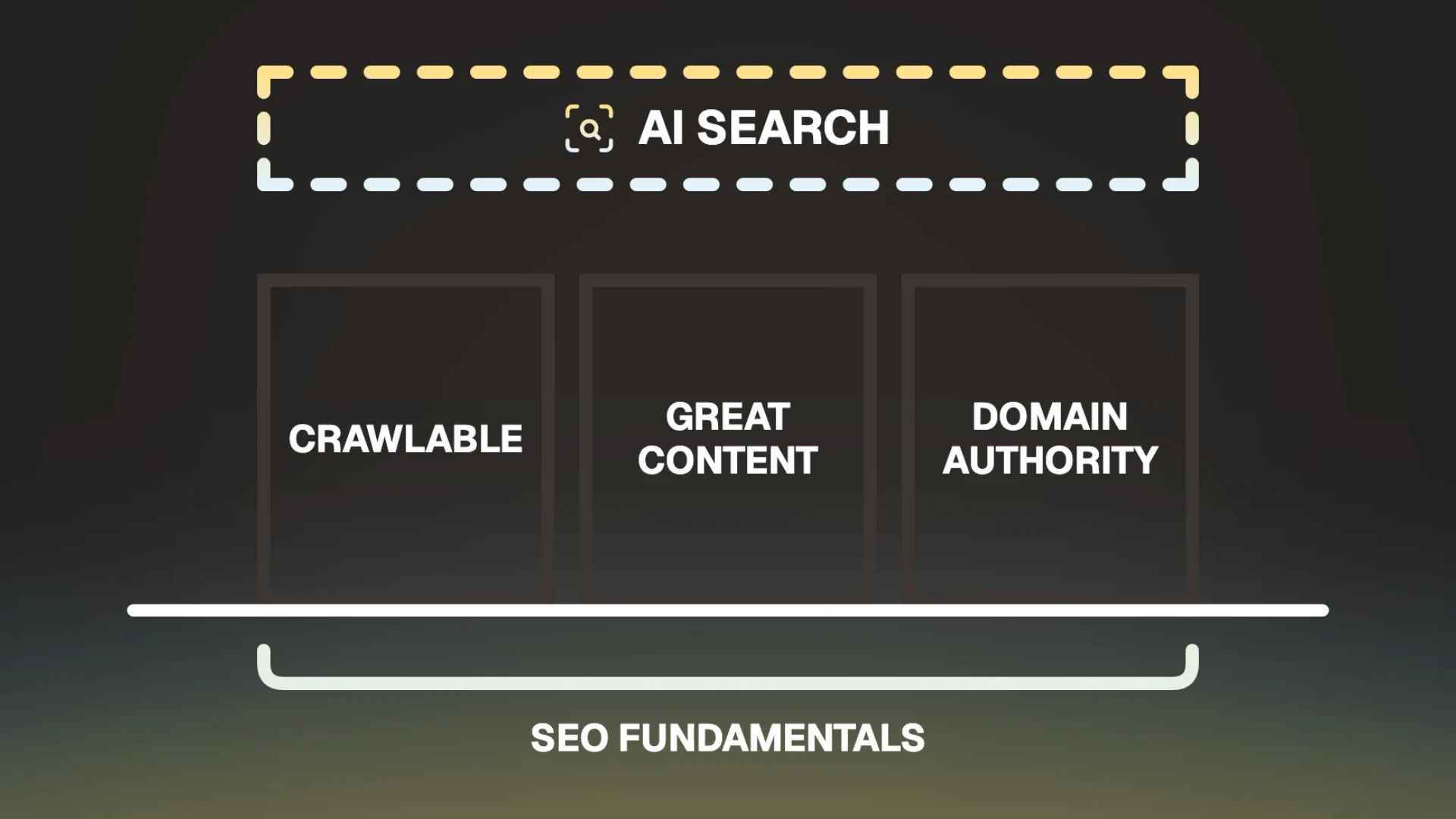
In other words, think of AI search optimization as an extension of SEO fundamentals, rather than a completely divergent practice.
3. Focus on blue ocean search opportunities
As a company starting out with little to no domain authority, you don’t have the luxury of targeting the most valuable keywords in your industry and hoping for success. For the same reasons mentioned in point #1, you’re unlikely to be able to rank for them in any reasonable period of time.
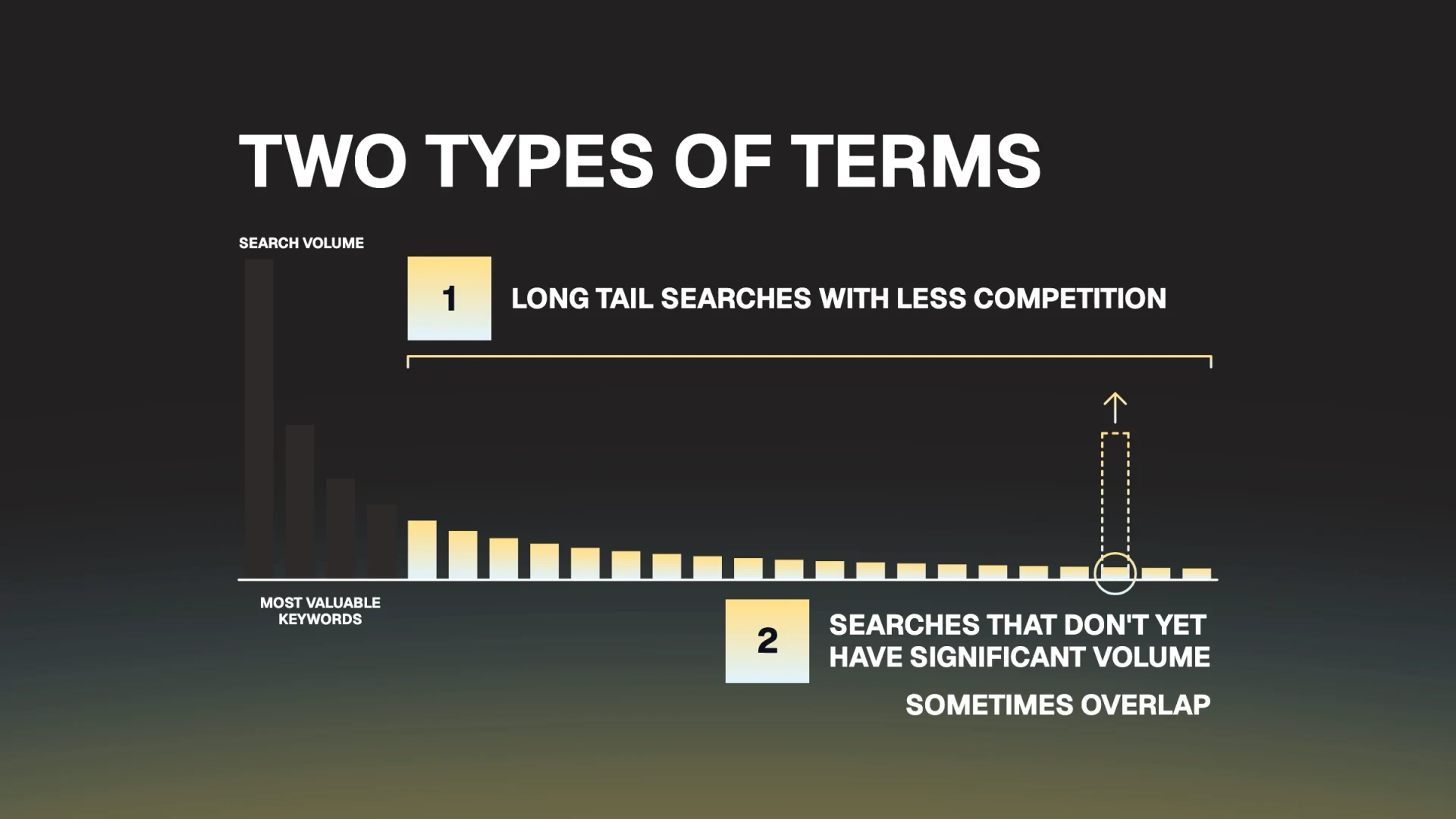
Instead, focus on two types of terms:
Long tail searches with less competition. Larger competitors with more mature domains will often forgo targeting smaller, lower volume search terms because they’re often insignificant relative to the traffic they’re already driving. These same terms can provide meaningful wins for a much earlier company in the same space.
When I ran my prior company, Flixed, a resource website for cord-cutters and streaming enthusiasts, we focused on targeting long-tail search terms related to niche queries about each individual streaming service – what channels each service supported, what devices they supported, what countries they were available in, and so on. We couldn’t compete for “Best streaming service,” but we could compete for “fuboTV supported devices” or “Sling TV channel list.”
Searches that don’t yet have significant volume, but may in the future. One of my best decisions while running Flixed was the decision to target search terms conforming to the format “How to watch [channel] without cable,” before live TV streaming services became popular.
These terms initially showed very low volume (often in the 0-100 searches-per-month range), but as cord-cutting proliferated across America, the search volume for these terms ballooned. In the end, the traffic generated from just these terms alone generated millions of dollars for us in affiliate commissions, via deals with the streaming providers we’d partnered with. The kernel of insight that inspired us to pursue this strategy didn’t come from a keyword search volume tool—it came from a firsthand, on-the-ground insight earned from paying close attention to the industry.
Beyond early-stage SEO & AI search optimization
It’s worth briefly mentioning here how the job of managing growth changes as you scale. Imagine you’re managing organic growth for a company with a fantastic product-market fit like Ramp, Lovable, or Clay—how does your job change, or not change?
The biggest difference is perhaps that domain authority becomes lessof an issue, given that at this point, the company typically has a compounding growth engine that has naturally propelled the company to a higher domain authority. This isn’t to say it’s a non-issue; you often will end up competing with other fast-growing competitors, but the challenge is noticeably less difficult than what you face as a very early company.
At this point, the focus of the organic growth manager often shifts towards targeting the most valuable terms in the industry, now that you have the domain authority to be competitive for it, ensuring that the website structure remains optimized for crawlability as the sheer volume of content on the domain grows, and embedding SEO strategy more deeply into the product’s foundations, rather than treating SEO purely as a marketing function.
Each of these topics could warrant a guide of its own, but we’ll save those for another day. Good luck on your 0 → 1 SEO journey, and feel free to reach out with any questions.