The terms SEO, AEO, and GEO will be rendered obsolete

Thenuka Karunaratne
CEO & Co-Founder, sunbeam
4 min read
The SEO community has been in a raging debate over the acronyms “SEO”, “AEO”, “GEO” since the release of ChatGPT, but I believe that all of these acronyms will be rendered obsolete over the next few years, as agents now move to fully embrace end-to-end task completion, whether it be for business (Codex, Claude Code building an application) or personal (Instinct or Muse completing work for you) purposes.
While earlier versions of ChatGPT and Claude had a traditional analog in Google as an “answer engine” or “AI search engine”, their evolution into agents that complete tasks rather than merely summarize large amounts of information represents a new phenomenon without a traditional analog – thus, they don’t neatly fit any of the pre-existing acronyms, including the newest ones.
Examining the terms “AEO” and “GEO”
Contrary to popular belief, the terms AEO (Answer Engine Optimization) and GEO (Generative Engine Optimization), which are now used more or less synonymously, did not arrive at the same time. AEO was first coined as a term in 2017 to describe the shift from ten blue links towards directly answering a question, either through Google’s snippets or through voice interfaces like Alexa.
GEO (Generative Engine Optimization) emerged after a paper titled GEO: Generative Engine Optimization was published by six researchers in 2023. To paraphrase their definition in the paper, they define Generative Engines (GE) as systems that “combine search engines with generative models.” They “dub these systems generative engines (GE) because they search for information and generate multi-modal responses by using multiple sources.” GEO, then, was their framework for optimizing content for generative engines.
Accounting for task completion
Both of these acronyms adequately account for the behavior expected from AI-assisted search surfaces like ChatGPT, Claude, or AI overviews. They pull from an underlying search index and use generative models to offer a single answer.
Do they adequately account for the task completion aspect of modern agents, like building an entire application for you (Codex, Claude Code) or canceling your recurring subscriptions (Instinct, Muse)? I would argue they do not.
Agents no longer resemble “answer engines”—they are now entities that complete complex tasks from end to end. What about “generative engines” then? GEO has a broader definition, and agents completing tasks do technically fit the definition of systems that “combine search engines with generative models.” The problem, however, is that no one refers to agents as “generative engines.” They refer to them as agents, plain and simple.
SEO must be retired as a term
What about SEO then? The oldest of these acronyms, the term “SEO” came to prominence around 1997, appearing shortly before the rise of Google. Unfortunately, as should be obvious, “SEO” captures even less of what modern agents have become. The ability to search the web is one of many capabilities that agents have, but their capabilities have evolved to far exceed that. SEO, of all these terms, is perhaps the least suited to meet the moment we’re in.
Conclusion
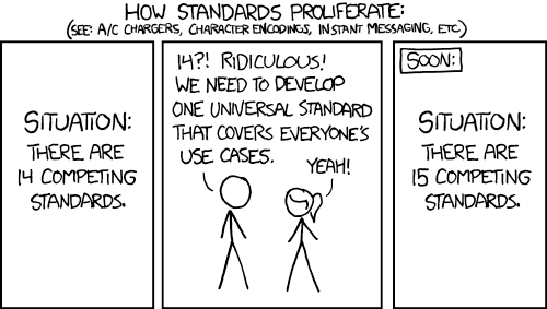
What is the solution then? Should we create yet another term? I’m tempted to offer the term “Agent Discovery” as a simpler and more accurate option, but I feel weary of pushing too far in this direction, for reasons this XKCD comic can articulate better than I can.